Tampilkan postingan dengan label Childrens. Tampilkan semua postingan
Tampilkan postingan dengan label Childrens. Tampilkan semua postingan
Rabu, 28 Juni 2017
April 23 My childhood vs My childrens childhood Part One
Another topic from a commenter:
"Here's an idea for you (that may take more thought than you want to put in), but maybe a post about how your kids' childhoods are/will be different than yours, and feelings on that? I've been thinking that over a lot lately and since I don't blog, I'm passing the idea to you :). I grew up in a rural area with a SAHM; my son is a city kid with two full-time working parents. As he gets older, I'm realizing there are some idealizations of my childhood that I have to let go of, and also some really amazing experiences my kid will get that I never had access to. Maybe that's way too deep ... but an idea. Pictures are totally fine too :)"
I find this to be an interesting comparison and one that I haven't specifically pondered until this comment. My initial reaction was that my upbringing and also my kids' upbringings will be quite similar, which is a subconcious goal of mine since I had a wonderful childhood (Nate, too!). But I guess when you really get down to it, there are plenty of differences to discuss as well. I hope it goes without saying that everyone has different childhood experiences and upbringings and that is totally fine by me! Just because I was raised one way doesn't mean it's the 'right way' or that someone else who wasn't raised like me is missing out. I feel the need for this disclaimer before I touch on a few heavy topics of childhood and priorities in raising children. This is just my own personal story and the ongoing story of my children. Differences are good! Okay then.
Big city versus small town upbringing:
I grew up in Jefferson City, Missouri which is the commonly forgotten Capital in the middle of the state. I thought it was a 'big city' with a population of about 45,000, which was gigantic compared to the tiny farming towns surrounding us in JCMO. My high school was huge since there were only two in our city: public (mine, graduating class of 800) or private (much smaller but still a huge competitor of ours in athletics). The size of my high school compared to the size of my hometown is kind of interesting, since I never realized other truly BIG cities had suburbs with their own schools, own little world, and their own culture. You either went to the public high school or the private one and that was that.
My kids are growing up in a suburb of Milwaukee that has roughly 45,000 people living here, which is basically the exact same size as my hometown. And in case this isn't already known: we live in the same suburb where Nate grew up, and his parents still live in Nate's childhood home just a mile away from us. But the big difference is that our suburb is a part of the Milwaukee metro area that has 1.5 million people calling it 'home.' So Truman, Cecelia, and Porter are definitely 'city kids' compared to myself.
And one of our favorite things about this suburb is the walkability: we can walk to school, walk to the downtown village, walk to playgrounds, etc., which feels very city-like. I definitely did not live in a walkable town growing up, we didn't have sidewalks, and my childhood home was built in the 1980s instead of our current home from the 1920s. That part doesn't really matter when it comes to 'upbringing' but I think our neighborhood and suburb have a much different feel than my hometown, too. I'll call Truman, Cecelia, and Porter city kids---but city kids in a suburb. I was a small town city kid with a side of farm girl;)
My kids are growing up in a suburb of Milwaukee that has roughly 45,000 people living here, which is basically the exact same size as my hometown. And in case this isn't already known: we live in the same suburb where Nate grew up, and his parents still live in Nate's childhood home just a mile away from us. But the big difference is that our suburb is a part of the Milwaukee metro area that has 1.5 million people calling it 'home.' So Truman, Cecelia, and Porter are definitely 'city kids' compared to myself.
And one of our favorite things about this suburb is the walkability: we can walk to school, walk to the downtown village, walk to playgrounds, etc., which feels very city-like. I definitely did not live in a walkable town growing up, we didn't have sidewalks, and my childhood home was built in the 1980s instead of our current home from the 1920s. That part doesn't really matter when it comes to 'upbringing' but I think our neighborhood and suburb have a much different feel than my hometown, too. I'll call Truman, Cecelia, and Porter city kids---but city kids in a suburb. I was a small town city kid with a side of farm girl;)
I went to St. Louis University and had a bit of a culture shock as I realized that I was considered a small town girl. Not to mention that when I chose a Jesuit college I didn't have a clue as to how different I'd be there since I was not Catholic and 90% of the kids there were at least 'sort of' Catholic. I think a lot of the city kids thought I was a po-dunk-farm girl-atheist or something, which was shocking since I believed myself to be a city girl with a solid religious background (more on that part in a bit)! My family did technically own a beef cattle farm, although faming wasn't my dad's primary job. Dad is a CPA who would change out of his business suit into his denim overalls and steel toed boots in the evenings to inseminate a cow or something crazy. So yes, I guess I was a bit of a 'farm girl' but we didn't live on the farm and I've never driven a tractor;)
More on my experience being somewhat of a religious outsider at college: I remember the first Ash Wednesday I experienced while at SLU. My friend Keri came to class with ashes on her forehead and I was perplexed, telling her that she had dirt on her face. Ah, I learned so much about Catholicism in college because of the religious studies we were required to take, but also because of my numerous Catholic friends in college. I have gone up to the front of church at more Catholic weddings than I can count---getting a blessing with my arms crossed over my chest instead of receiving communion became more comfortable for me with each subsequent wedding. Which brings me to another topic when comparing childhoods.
Religion:
Religion:
Although I went to a public high school, I attended a Lutheran grade school from kindergarten through eighth grade. Which is ironic because we went to a Baptist church--one that was a very prominent feature of my childhood as we went every Sunday, most Wednesday nights, did vacation bible school and Sunday School, and my mom was employed by our church for many years. Papaw was even the very first pastor at our church, so it was definitely a big part of my childhood. But my dad grew up Lutheran and attended the same grade school that I did, so I had a nice blend of denominations as I formed my own faith base. Lutheran grade school, public high school, Baptist church, and then a Catholic university. This could have become quite confusing for me but I am thankful for the variety of religions I've been exposed to over the years.
As for my kids: Nate was brought up Catholic but married me in an art gallery with my Baptist grandfather officiating;) And now we attend a Lutheran church because I consider Lutheranism a nice compromise between Catholicism and Baptists. Nate and I really enjoy our church mostly because it's laid back, geared towards families with young children, and the pastors are fantastic. But one way in which my kids will have a different upbringing than my own? We do not go to church every Sunday (shame, shame--I have Catholic guilt for this without being Catholic). For awhile when it was just Truman and even into the baby Cecelia days, we did make it every-other-Sunday and I believe someday we'll make that a priority again. But right now during this chaotic stage of life with three very small kids, it's just not. I believe we can still teach our children about God and faith and religion without going to church every Sunday.
For instance, Truman is really into this storybook Bible these days:
For instance, Truman is really into this storybook Bible these days:
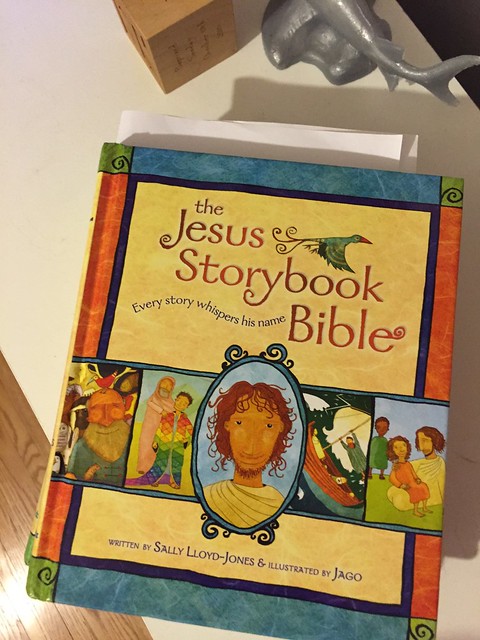
We will read stories from it and discussions are prompted about God, Jesus, faith, and being kind to others. Truman also loves any of the stories that have to do with battles and death and I sort of forgot how intense a lot of the biblical stories can be. I mean, the crucifixion in general? BIG topic of discussion and something that I'm sure we will continue to talk about for years to come. At least, I hope we do! Cecelia doesn't 'get it' yet but reading stories with Truman is one way that the kids are getting exposed to religion without attending church every Sunday. Plus, Christmas and Easter are both opportune times to steer the kids towards the real meaning of these holidays. But of course, opening presents and eating candy are a hundred times more kid friendly than the birth and death of Jesus. BUT ANYWAY, religion was a huge part of my upbringing and it's also a part of my kids' lives. But probably not as prominent as it was for me as a child. When discussing religion at all, I feel the need to say that everyone is different here and it's alright if you weren't/aren't religious and don't want your kids to be either. I hope talking about faith isn't offensive because yes, it can be a sensitive subject!
Schooling:
Already touched on this one, but Nate went to public schools for elementary, middle school and high school, then met the love of his life at a Jesuit college;) I went to private grade school/middle school, public high school, and was Nate's love of his life at the Jesuit college. Nate even attended the exact same middle school and high school that our kids will attend, different elementary schools only. Our kids will go to public schools until college and then I will pray with everything I have they choose a state school after high school. Private colleges are beyond my comprehension for tuition costs so hopefully all three of our children are GENIUSES and get extremely awesome scholarships somewhere (that goes for a state school or a private school, actually). Be geniuses, kids!
So size of the city=different, religion=same but different, and schooling choice=same. More on the concept of the family unit next.

Minggu, 23 April 2017
Incentives Rewards for Childrens Behavior Part 2 of 2
I've been asked many times for specific strategies for incentives and rewards with the children, so in Part 1 I presented to you 9 ideas which we implement in our home. In this Part 2 I would like to share with you our Points and Rewards System to be implemented when we leave the children with a babysitter. *smile*

- The general idea
- The rules
- Ideas for reward containers
- My chart for keeping track
*************************
The general idea
The children earn points each time mom, or mom and dad together go out. They can then spend their points at the culmination of each babysitting time, or they may choose to accumulate points and save for larger rewards.
The rules
* Earning points:
Each time mom and dad go out, each of the youngest children earns 5 points. If I go out during the day for a dentist appointment or such and it will only be 90 minutes or so then I only give them each 3 points.
The oldest two teenagers earn the base 5 points, plus the oldest teenager earns 3 points per hour (of awake time), and the next oldest teenager earns 2 points per hour. They earn more points because they know the family's routines and so do directing of children's activities and the food prep.
Our teenagers quit earning points at the time when lights are supposed to be out at 9:00 pm, regardless of what time mom and dad return and the babysitter leaves. There can be some exceptions, however, such as babies or toddlers having difficulties after bedtime.
* Losing points:
A child loses one point for each infraction, but may lose all of their points or even into the negative for that day. We tell the babysitters not to give warnings - if they feel a warning is warranted, then the child needs to lose a point.
We did make an exception, however, for the first several times that we implemented the points rewards plan to help younger children get used to keeping on the forefront of their mind that they have points they are trying to keep by making good choices.
A teenager can lose points for being unfair or getting the children to bed too late. We haven't told the children the rules for teenagers losing points, though. And we give the teenagers the benefit of the doubt in decision making, knowing that they have extra responsibility with mom and dad gone for a little while.
In the past we've taken away one point from everyone when we've come home to a messy house due to children refusing to participate with cleaning up over the course of the time.
* Young children earning, losing, and receiving rewards:
For a 2-year-old or younger we wouldn't do points at all.
For 3 or 4-year-olds we use "visible points" because a scribble on a sheet of paper means nothing to them. A teenager gets 5 points out and puts them in a clear glass cup or mini-bowl (i.e. 5 chocolate chips, M&M's, gummy bears...you get the idea).
At the beginning of the evening the teenager shows the younger children their cup and cheerfully explains what that is for and when she will get to eat them (which is the next morning - explanation for this to follow).
Every time a little one whines, disobeys, hits, or otherwise needs to lose a point, the babysitter is to kindly and patiently take her to her point cup and explain why she is losing a point and puts the point away. Babysitters or teenagers are not allowed to eat the point though as this could cause bitterness from the young child.
The children then get to eat their points the next morning. The reason for this is because if they are allowed to eat their points at bedtime, then they know the babysitter can't take away any more and and they have been tempted to then take advantage of that situation. (How do they get so smart at such a young age?! *chuckle*)
* Spending points for rewards:
We also rarely encourage the younger aged children to save points because we know that they need their gratification closer to the time when they had to work for it. However we have been surprised at how quickly they caught on to the benefits of saving for bigger rewards.
* Videos
This is allowed on longer babysitting times, such as mom and dad's weekly date night. Reasons for this are two-fold. (1) To help the babysitter and teenagers, and (2) to help the children be more excited that we are going on a date.
We let the children watch a video of their choice from the cupboard of parent-approved videos, or from our Netflix queue of pre-selected videos. The children can work out a system of taking turns picking the video. If a child has a bad attitude about the video their sibling chose, then the bad attitude child must skip their next turn for choosing a video.
Video rules:
- All dishes and dinner clean up must be done first, along with any evening chores the children might have such as putting away the day's laundry.
- The children need to get into their pajamas first, have teeth brushed, and generally be ready to crawl into bed after the video.
- Our friends who created this points system choose to have the selected video follow a 30-minute Christian-based video first, so that it's not just a night of pure brainless entertainment. *wink* We've not chosen to implement this personally, as the typical 90 minute movie already maxes out our younger children's attention span. And, we do not own more than a couple Christian videos (we don't own hardly any DVD's at all but choose to utilize Netflix almost exclusively, or the library). But from what I've found Netflix only offers Veggie Tales for 30-minute Christian videos and only a handful of those are "instant play".
- the video must either be finished or turned off in time for lights-out time.
The children earn rewards in about 4-hour blocks of time throughout the day. This way the children are receiving the rewards of their efforts for good behavior in reasonable amounts of time. And, if someone is having a difficult time for part of the day they have a re-start point built in a couple of times.
We give 5 points for each of three block of time over the course of an entire day from 8:00 am - 12:00, 12:00-4:00, and 4:00 - 9:00 pm. So over the course of 2 days the children have the opportunity to earn up to 30 points, and the teenagers as much as 44 points in a day to be spent however they like.
Ideas for reward containers
When we began the points and rewards system I went shopping to establish our first cache! *smile* I headed out to the local Dollar Tree, and to Wal-Mart to establish our reward system items. For younger children I found abundant non-food items at the Dollar Tree, and have found the food reward items at Wal-Mart, as well as some good non-food rewards.
The teenagers choose their own rewards to have on-hand for when they've accumulated enough points. They typically choose rewards such as clothes, lattes, hair jewelry from Lilla Rose, make up, clothing accessories, or simply trade in points for cash to save up for larger items they would like.

Examples of rewards:
1 Point -
- 1 Skittle
- 1 Mike & Ike
- 1 Candy corn
- 1 M&M
- 1 Hot Tamale
- 1 rubber band hair holder
- Any really little...

5 Points: (think 5 Skittles-wroth)
- 1 Lifesaver
- 1 Starburst
- 1 Hershey's Kiss
- One packet of Hot Chocolate (marshmallows to cover the top = 3 pts. more)
- 1 Sticker sheet
- 1 three-inch glow in the dark bug
- 1 piece Sidewalk chalk
- 1 mini sticker-tape dispenser (Dollar Tree, pkg. of 3)

10 Points: (think 10 Skittles-worth)
- 1 Ring Pop
- 1 pkg. of Smarties
- 1 Reece's Peanut Butter Cup
- 1 Peppermint Patty
- 1 small chocolate bar (2-inch-size)
- 1 small lunch bag size Potato Chips
- 1 Matchbox car
- 1 Headband
- 1-half package of refill caps for cap guns
- Bubbles
- Army men
- Rubber stamps
- Rubber stamp ink pad

20 Points:
- 1 small package of fruit chews
- 1 small package of animal cookies
- 1 small Chocolate bar
- 1 whole package of refill caps for cap guns
- 3 sets of earrings (a card of 9 sets of earrings cut into 3 portions).
- 1 Headband
- 1 package of elastic hair holders
- Hair clips
- 1 Bandana
- Garden gloves (Dollar Tree)
- A Doll set of brush/comb/mirror (Dollar Tree)
- 25-piece Puzzle (Dollar Tree)
- Socks
- Pens, Pencils, Erasers, Mechanical Pencils
- Squirt guns

35 Points:
- 1 one-cup size container of cookies
- 1 regular-size package of Skittles or candy
- 1 pkg. Corn nuts
- 1 Ice cream bar (or a coupon for one)
- A full-size tape measure (Dollar Tree)
- Tools (clamps, screwdriver, hammer...)
- A mini flashlight (Dollar Tree)
- A book light (Dollar Tree)
- An 8-inch plastic dragon or dinosaur (Dollar Tree)
- Action figures
- Scented lotion (Dollar Tree)
- Scented hand soap (Dollar Tree)
- Package of stickers
- Umbrella
- Books

50 Points:
- Certificate for an Ice Cream Cone
- Cap guns
- Nerf dart guns
- Sunglasses
- Model ships/airplanes, etc.
- Clothing
- Clothing accessories
- Lilla Rose Flexi Clips
- Make up
- Books
- Coffee beverages
- Cash in exchange for points

* Food items are always valued higher than non-food items because we'd rather they buy non-food items; but we know how special the food items are so we will always allow them in our reward system.
* Non-food items are valued at 10 points for $1.00 generally
My chart for keeping track
The friends we got this points and rewards system idea from initially used a tablet to keep track with, and eventually developed an Excel spread sheet. I personally prefer creating charts in Microsoft Word "tables", so that is what I did for our family (you may share my template from Dropbox if you'd like, for FREE). Here is the chart I print out and keep one current page of on the refrigerator. *smile* We keep a running record of what is earned, what is lost for poor behavior, what is spent on rewards, and what is the running total for each person. And the children can reference this at any time which is also an incentive in its self.

Here is my plan for recording points and acquiring the rewards:
I recognize this may seem like a lot. But it's very simple, really, especially once you get into the habit of giving the points, then keeping track of who lost and who spent. That's all it is. Our children all caught onto it immediately. The most amount of time goes into simply shopping for your initial rewards supplies, but then you're good to go having found where you'd like to buy things and replace them as they run out. And it's so worth it in my opinion! Our children then do beautifully each managing their own behavior while we're gone, making the babysitting time really pleasant for all.
Our children have all been extremely enthusiastic about this new points and rewards system! *cheer!* They all look forward to it every single time I need to go out, and the youngest children are frequently asking me when I'm going to go out again so that they can earn more points. Perfect. *smile* I hope this idea can be a blessing for your family as well, and I'd love to hear about how it works for you!
Blessings on your family efforts,

Resource:
Here in Dropbox you may print for FREE the points and rewards system rules written out for your reference.
Other related posts of mine you might enjoy:
Here is my plan for recording points and acquiring the rewards:
- I am the only one to do any recording of points earned or lost or spent.
- Each time I go out I record the date, and I record the description of the event for which I'm going out such as our weekly date night.
- Each event of going out uses two rows, a white one and a shaded one.
- I write down in the white "+" (given) column how many points each person is given upon my departure.
- While I'm gone, the babysitter keeps a running list on a post-it note of any points that were lost. This usually references only 1 or 2 people. When I get home we go over the list together and make sure it's justified and everyone understood why points were lost. I also talk to the babysitter, and teenagers tell me how each other did.
- In the morning we then settle up the earned points.
- In the white "-" (taken away) column I record any points that were lost due to poor behavior or disobedience.
- Next I go through each child one at a time, youngest to oldest, and either serve their remaining "visual points" from their glass bowl or allow them to go shopping in the rewards containers to spend their saved accumulated points.
- I record in the shaded "spent" row below in the "-" column any points that were spent.
- Then I record in the "=" column the remaining running total of points for each person.
- Once each person has settled out I do not allow them to go back and change their mind, deciding to spend points that they previously decided to save. Done is done.
- I am the only one to help children shop in the rewards containers.
- (In this photo of my chart, the teenagers column's are not accurate because I forgot that once to give them both the base 5 points, and then the additional per-hour points. Usually their earned points for a 3-hour babysit would equal the base 5 points, then 2 or 3 points per hour depending on if they are head or assistant babysitter. So for a 3-hour sit they would earn 14 points for the oldest teenager, and 11 for the next oldest.)
I recognize this may seem like a lot. But it's very simple, really, especially once you get into the habit of giving the points, then keeping track of who lost and who spent. That's all it is. Our children all caught onto it immediately. The most amount of time goes into simply shopping for your initial rewards supplies, but then you're good to go having found where you'd like to buy things and replace them as they run out. And it's so worth it in my opinion! Our children then do beautifully each managing their own behavior while we're gone, making the babysitting time really pleasant for all.
Our children have all been extremely enthusiastic about this new points and rewards system! *cheer!* They all look forward to it every single time I need to go out, and the youngest children are frequently asking me when I'm going to go out again so that they can earn more points. Perfect. *smile* I hope this idea can be a blessing for your family as well, and I'd love to hear about how it works for you!
Blessings on your family efforts,
Resource:
Here in Dropbox you may print for FREE the points and rewards system rules written out for your reference.
Other related posts of mine you might enjoy:
- Incentives & Rewards for Children's Behavior, Part 1 of 2
- "Raising Real Men - Surviving, Teaching, and Appreciating Boys"
Langganan:
Postingan (Atom)